

AI Training
Capability across your whole team, with the confidence to use it.
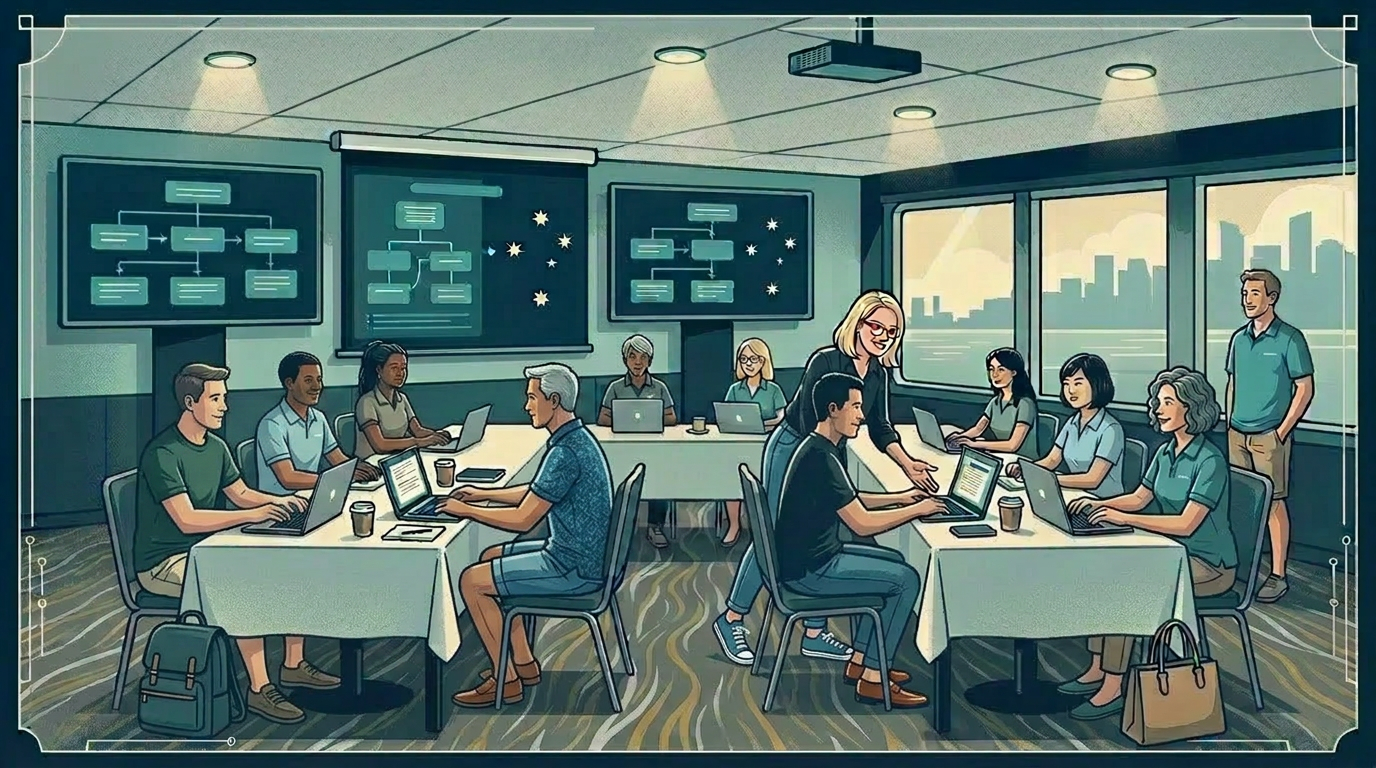
Most organisations have one or two people who ran ahead with AI and a dozen more quietly unsure what is allowed. Training closes that gap: live, role-based sessions that leave the team fluent in the sanctioned tools, clear on the boundaries around them, and able to spot the next opportunity themselves. Capability that sits across the organisation holds when any one person moves on.
Where self-taught stops
Self-taught use has a ceiling, and a cost.
A team that taught itself AI tends to use it like a search engine: shallow prompts, unverified output, and results that vary with whoever happens to be typing. The rework that follows can absorb more time than the tool saves, and self-taught exploration quietly consumes production hours that were never allocated to it.
The spend follows the same curve. Subscriptions multiply, seats sit idle, and few teams know when a task belongs on a subscription and when it belongs on the API, or how to stay diligent about token usage once it does. We have watched businesses report rising AI costs and falling efficiency in the same quarter. Training closes both gaps at once: a shared standard of what good use looks like, and the judgment to put AI where it returns the most, taught in the context of the actual job.
Hover the chart to see the gap
From the log book
Proven in the field.









Where to start
A day, a department, or a champions programme.
A live training day, a deeper capability day by department, or a champions programme that carries the standard forward. Each is priced, each is taught on the tools already in your hands, and each ties back to the policy that governs them.
Hover or focus a waypoint to see what is inside
Training day
USD $1,700
One day, live, in person or online: the foundations of capable, safe use, taught on the tools the organisation has actually sanctioned, with your policy woven through it.
Inside this waypoint
- A shared standard of what good use looks like.
- Prompts and patterns from your live tasks, kept afterwards.
- The boundaries taught alongside the capability.
Capability day
USD $2,500
A deeper day, run by department: directors, operations, marketing, and quoting each work on their own live tasks, and leave with working patterns rather than notes.
Inside this waypoint
- One department, one set of live tasks, one working day.
- Working patterns the team can run inside a week.
- A short read of tools and roles before the day.
AI Champions programme
By agreement
A multi-session programme that builds internal champions who cascade capability through the organisation, so the practice hands the teaching over rather than holding it.
Inside this waypoint
- A small group learning deeply across several sessions.
- Materials the champions can teach from internally.
- A rhythm of check-ins that keeps the standard current.
Refreshed as things change
Self-serve modules ship with the keep-current subscription, and Navigator carries live refreshers as tools and rules move.
In the working week
What the team walks away with.
These are the shifts a training day is designed to produce in the working week.
A shared standard of what good use looks like.
The habit of checking output before it travels.
Prompts and patterns built on real tasks, kept afterwards.
Champions who carry it forward internally.
An onboarding pathway for every new starter.
Training tied to your policy rather than to generic tools.
The Champions programme
Capability that compounds.
For organisations that want capability to keep growing after the sessions end, the Champions programme runs over multiple sessions: a small group learns deeply, teaches internally with our materials, and meets on a rhythm to keep standards current.
It is the difference between a training day the team remembers and a capability the organisation keeps. Scoped by agreement, sized to the team and the tools in play.
One teaches three. Three teach nine.
Practice
The standard is set here.
Champions
A small group taught to teach.
Wider team
Capability carried internally.
Delivery
How a training day runs.
Four movements, in sequence, so a session is prepared against your reality and leaves a pathway rather than a memory.
Before
A short read of your tools, your policy, and the roles in the room, so the day is taught on your reality.
Inside this stage
- A read of the tools already in use.
- The policy woven into the day, not bolted on.
- Roles named so the exercises fit the room.
On the day
Role clusters working on live tasks, with the boundaries taught alongside the capability.
Inside this stage
- Live tasks the team brought in, not generic prompts.
- The boundaries taught next to the capability.
- Working patterns the team can run tomorrow.
The materials
Patterns, prompts, and guardrails written down and left behind.
Inside this stage
- Prompts and patterns captured from the day.
- Guardrails written down, not held in memory.
- A reference the team keeps after everyone leaves.
After
A training pathway for the organisation, sequenced to the obligations and tools identified.
Inside this stage
- Next sessions sequenced to the tools and rules that reach you.
- A pathway new starters can be onboarded through.
- Refreshers scheduled as tools and rules move.
Destination
A training pathway
Sequenced to the obligations and tools identified, so the next session goes where it is needed most.
Kept current
Kept current as the tools change.
Tools change monthly and rules change quarterly, so a one-off session ages the way a policy does. Self-serve modules ship with the keep-current subscription, refreshers run under Navigator, and the Champions rhythm keeps the internal standard moving with the outside world.
A trained team works best alongside a written position: Governance Essentials stands up the policy your training teaches to.
Before and after
Training sits between the policy and the practice.
Who it serves, who delivers
Built for organisations sitting under overlapping regulation.
Maritime is many different organisations: yacht operators and managers, insurers, builders and equipment makers, passenger vessel operators, marinas and ports, and the professional services around them. What connects them is the weight of overlapping, multi-jurisdictional regulation that touches everything they do. Southern Sky AI works in that shared complexity. The practice is led by Kristina Agustin, legally trained, with more than twenty years in international superyacht and maritime operations, and supported by a specialist delivery bench, so the judgment stays senior and the capacity is never one person.
FAQ
Common questions.
Qualified in law, certified in AI, trained at sea.







Start with your position
See where capability sits today.
Start by seeing where capability sits today. The AI Baseline reads your organisation's position in about five minutes and ranks the moves that matter, training among them.
Get your baselineGive the whole team the same footing.
The AI Baseline reads your position in about five minutes and ranks the moves that matter. It is the plain starting point.